

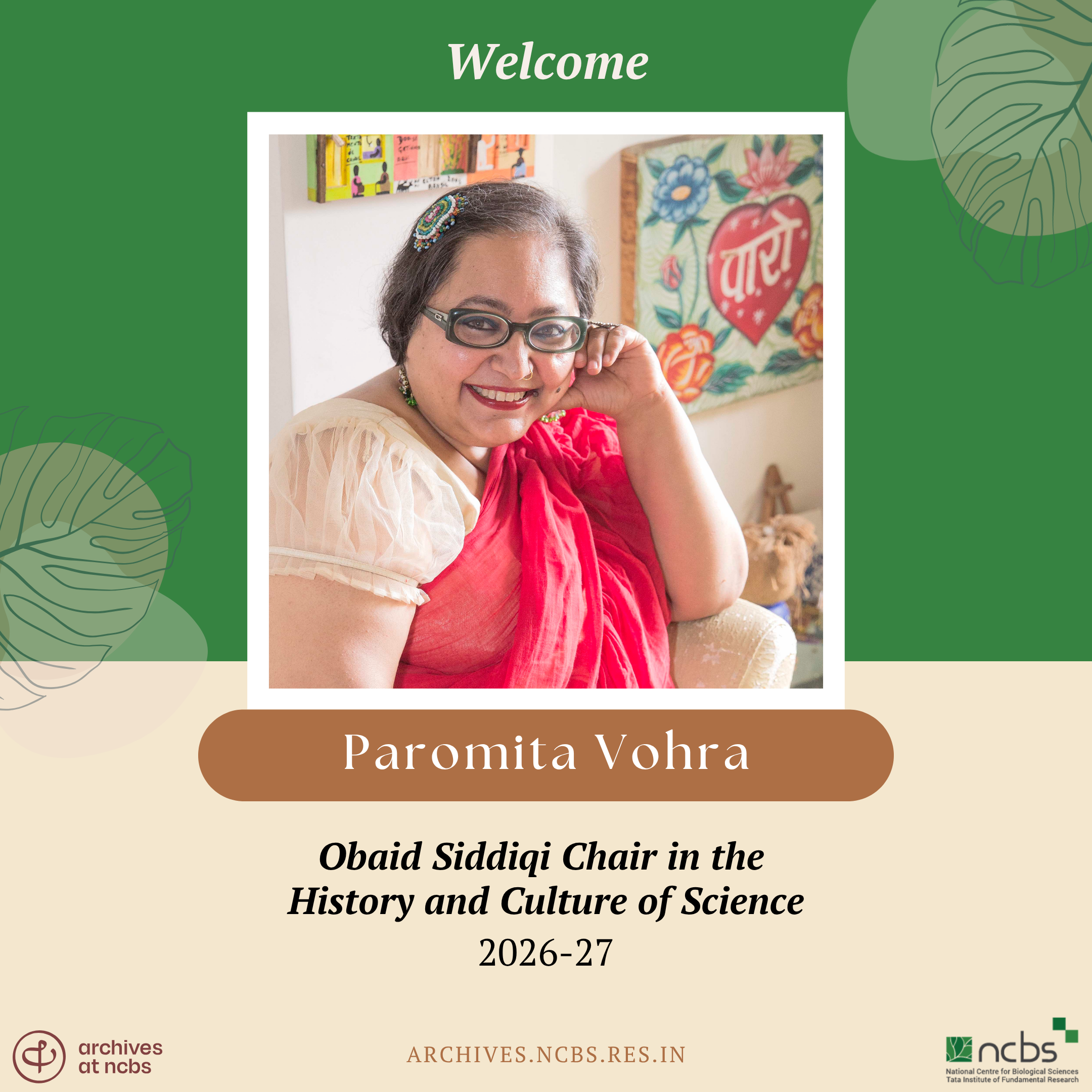
We are delighted to announce that Paromita Vohra will be the sixth Obaid Siddiqi Chair for the academic year 2026-27. The Obaid Siddiqi Chair in the History and Culture of Science is an initiative designed to bridge the gap between the sciences, social sciences, and humanities (https://archives.ncbs.res.in/OS). It is made possible by a generous grant from the TNQ Foundation. This chair aims to deepen interdisciplinary understanding of the history and culture of science.
Paromita Vohra is an award-winning filmmaker, writer, and digital creator known for films such as Working Girls (2025), Partners in Crime (2012), and UnLimited Girls (2002), and for founding Agents of Ishq, a groundbreaking digital platform on sex and love that began in 2015. She has worked on screenplays, short fiction, essays, comics, and a 15-year-long weekly newspaper column, Paronormal Activity. Her work has been exhibited at the Tate Modern, Wellcome Trust and National Gallery of Modern Art, and is part of curricula worldwide. She has over 30 years of practice at the intersection of creative production and scholarly research, and her work is dedicated to expanding the language of Indian documentary and feminist discourse. Vohra’s work operates as living archival practice – documenting, curating, and reinterpreting cultural memory around gender, sexuality, popular culture and everyday life in India.
As the Obaid Siddiqi Chair, Vohra aims to explore how ‘uncategorisable’, in the context of archives, can be understood not as a lack, but as a quality with its own force. She will look into the methods, tools, and aesthetic strategies that such a condition demands, and the challenge that it might pose to the authority of familiar classifications. “I am looking forward to researching the personal papers of women scientists, to track the 'memoir' of sorts nesting in their interests, curiosities, emotional histories, experiences linked to identity if expressed, as well as their work to develop a more expansive narrative of what we consider scientific temper and the lens through which we understand the idea of achievement,” says Vohra. Her work will examine collections in the Archives at NCBS, particularly the Jamal Ara Papers, that suggest layered narratives of criss-crossing identities, including caste, community, and public life, in order to create multimedia visual art.
The Obaid Siddiqi Chair is part of an active effort at NCBS to bring together scholars from a variety of disciplines and explore intersections with the sciences. “We know that the kind of disciplinary divide between the sciences and humanities/social sciences and art we grow up with is not true to the nature of knowledge. Different disciplines explore different dimensions of the same thing – a felt reality, a social or cultural reality as much as an evident reality. To keep them separate is to see the world with half a frame, to build a world of hierarchies and exclusions. How can the lenses of the past liberate us into the present to imagine different futures? The position of the Obaid Siddiqi Chair imagines a relationship of maitri, a comradeship between disciplines. Like friendship, it can make for an egalitarian, heterogenous and enlivening world of knowledge building. This position is an invitation to conversation and mutual learning, a suggestion to abandon rigid frames in favour of something more fluid, something simultaneously full of both wonder and justice,” says Vohra.
“We are delighted to welcome Paromita Vohra as the 6th Obaid Siddiqi Chair at NCBS, reinforcing our commitment to examining science through both historical and modern cultural lenses. Her insights will be instrumental in advancing campus diversity and inclusion, while inspiring fresh perspectives that elevate the quality of our scientific research,” says Prof. LS Shashidhara, Director of NCBS.


0 Comments