

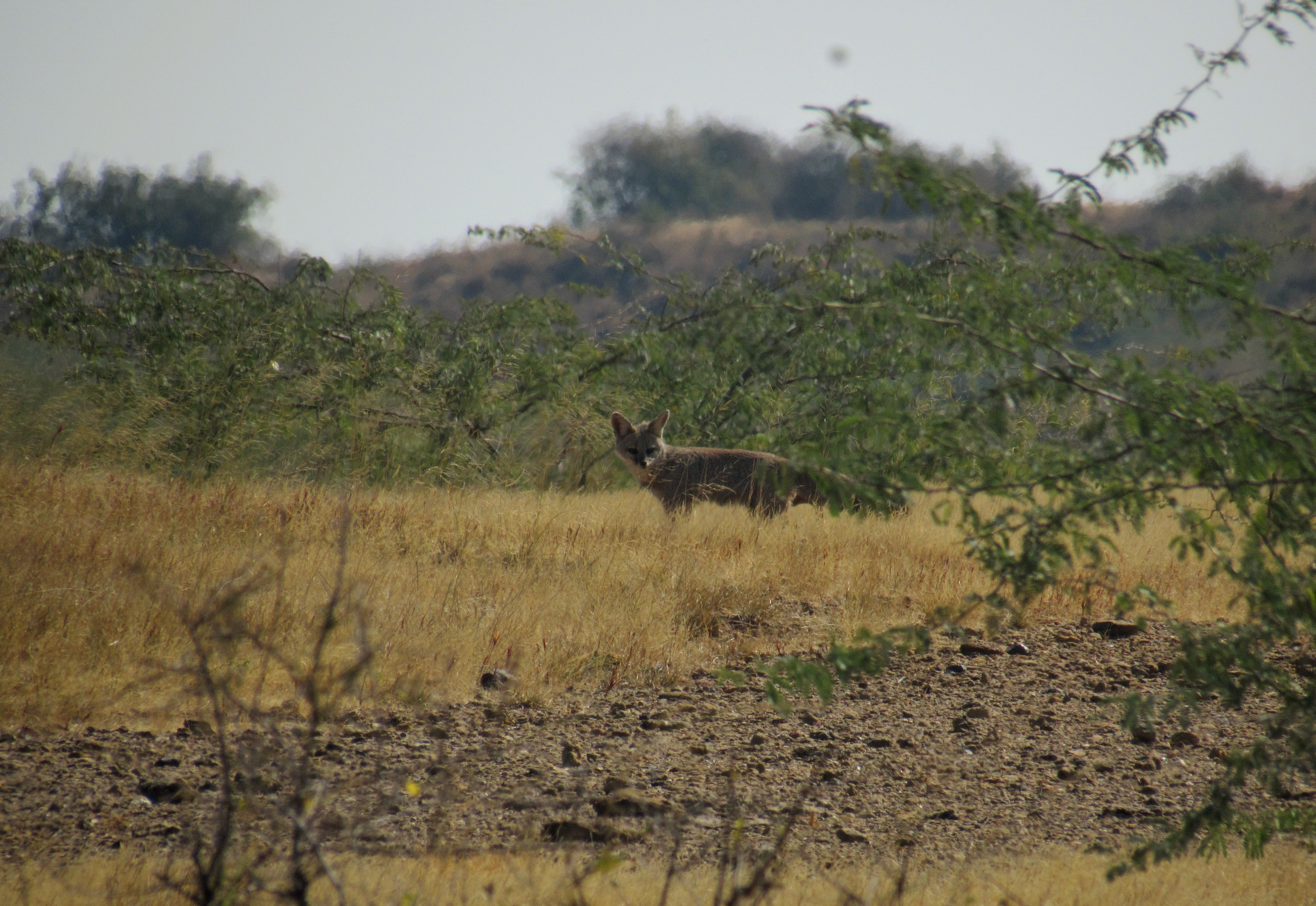
In India’s semi-arid savannas, survival is rarely a solo act. These sun-scorched landscapes are home to a suite of mid-sized predators like jackals, foxes and wild cats. These animals have learned to navigate sparse vegetation and extreme temperatures. But as roads slice through grasslands and human settlements spread outward, these animals are increasingly forced into closer contact with one another, and with people. A recent study at NCBS explores how such landscape changes are quietly rewriting the rules of coexistence among meso-carnivores in the Kachchh region of western India.
“Human activities have altered more than 95% of the world’s ecoregions, often fragmenting habitats and reshaping wildlife communities. In semi-arid ecosystems, where natural productivity is already limited, even small changes can have disproportionately large consequences,” says Divyajyoti Ganguly, the lead author of the study. Divyajyoti and team focused on a community of four meso-carnivores: the golden jackal, jungle cat, Indian fox and desert cat. These species share space, prey and human-dominated landscapes. Their goal was to understand not just where these animals occur, but how they interact with one another when natural savannas shrink and infrastructure expands.
The researchers began by mapping potential habitats across the landscape and assessing the degree of fragmentation. Open savannas are one of the most threatened native habitats in India. These grassland ecosystems emerged as the most fragmented, yet they were also positively associated with the presence of three of the four carnivore species. Even when reduced and broken into patches, savannas remain critical refuges.
“To better understand how these species share space, we combined camera trapping with indirect sign surveys and analysed the data using occupancy models,” says Dr. Arjun Srivathsa, co-author of the study. The researchers also incorporated anthropogenic variables, such as proximity to roads, to test how human disturbance might mediate interactions.
Study findings suggest that body size plays a role in shaping spatial overlap, with hints of dominance hierarchies influencing who shares space with whom. Species that overlapped in space often overlapped in time as well, and those with temporal overlap tended to aggregate at fine spatio-temporal scales. In other words, these carnivores are not simply overlapping with each other; in some cases, they are being coerced into sharing spaces.
The presence of human infrastructure alters their interaction dynamics. Species pairs were less likely to co-occur in heavily modified areas such as metalled roads. Human disturbance appeared to mediate interactions, potentially intensifying competition in remaining natural patches while reducing joint use of disturbed sites. “We’re seeing carnivore species using the same spaces more and more,” says Prof. Uma Pamakrishnan, a senior author of the study. “If that overlap keeps increasing, and animals don’t have enough room to avoid each other by changing when they are active or how they behave, it could lead to more direct competition. Over time, this kind of pressure can push out the species that are less competitive.That would mean a simpler carnivore community, with fewer differences in roles and behaviours, and a gradual loss of the ecological richness that makes these systems stable and resilient,” she explained.
The article titled “Three’s Company: Human infrastructure and diminishing savannas accentuate meso-carnivore interactions in a shared landscape of western India” was recently published in the international journal Biological Conservation. The authors are Divyajyoti Ganguly, Arjun Srivathsa, and Uma Ramakrishnan from the Wildlife Biology and Conservation Program at the National Centre for Biological Sciences – Tata Institute of Fundamental Research, along with Divya Vasudev from Conservation Initiatives.
Link to the study: https://www.sciencedirect.com/science/article/pii/S000632072500655X?via%3Dihub


0 Comments