-
What makes the black tigers of Similipal black?
A team of scientists have discovered the genetic cause of the odd coat colouration and patterning in Similipal’s black tigers.
-
Experimenting during the pandemic
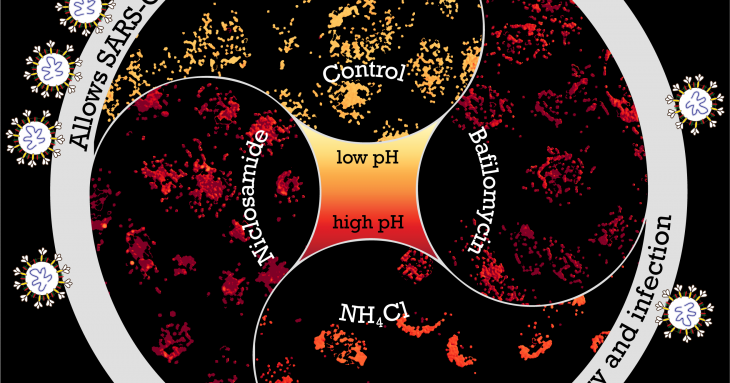
Endosomal acidification inhibitors target SARS-CoV-2 entry and infection. Image by Chaitra Prabhakara; Design by Chaitra Prabhakara and Sowmya Jahnavi.
-
Life is beautiful: Number of butterflies species rises to 74 in 2020 Delhi census
The survey was conducted during the big butterfly month held in September 2020.
Read more at:
-
More Fun Than Fun: Evolution on Islands in Water, in the Sky and Elsewhere
The sky islands of the Western Ghats have hitherto remained poorly studied, but now that is changing thanks to some remarkable work by V.V. Robin and his students and collaborators, including Uma Ramakrishnan at NCBS.
-
NCBS welcomes new faculty member: Tapomoy Bhattacharjee
The National Centre for Biological Sciences is delighted to welcome Tapomoy Bhattacharjee, who joins the NCBS as its newest faculty member. -
Workshop on endangered ‘Snow Leopard Population Assessment in J&K" inaugurated
A workshop organised on snow leopards included training from experts at IME, NDF, JU, WWF, NCF, and NCBS.
-
NCBS welcomes new faculty member: Swadhin Chandra Jana
The National Centre for Biological Sciences is delighted to welcome Swadhin Chandra Jana, who joins the NCBS as its newest faculty member.
Swadhin is a cell and developmental biologist fascinated with the molecular mechanisms underlying the assembly, functioning and homeostasis of macromolecular complexes and cellular organelles. He joins the NCBS from the Instituto Gulbenkian de Ciência (IGC)- Portugal (PT), where he holds a Principal Investigator position (on a Research Grant funded by Fundacao Ciência e Tecnologia-PT), since autumn 2018.
-
Listening to the stories of our people, lands and waters
First Chair ready to foster History and Culture of Science at NCBS
-
Knowing the ways of the coffee white stem borer
Prof. Olsson and a team of researchers have been studying the coffee white stem borer. Their aim is to study the insect and the way it approaches various plants and its response to plant volatiles so that a ecologically derived management strategy can be worked out. According to her, historically, it has been noted that the beetle attacks only arabica unless the area is heavily infested. However, recent studies by the team, published in the journal Frontiers in Ecology and Evolution, have shown that this is not because the beetle is more attracted to one variety than the other.