

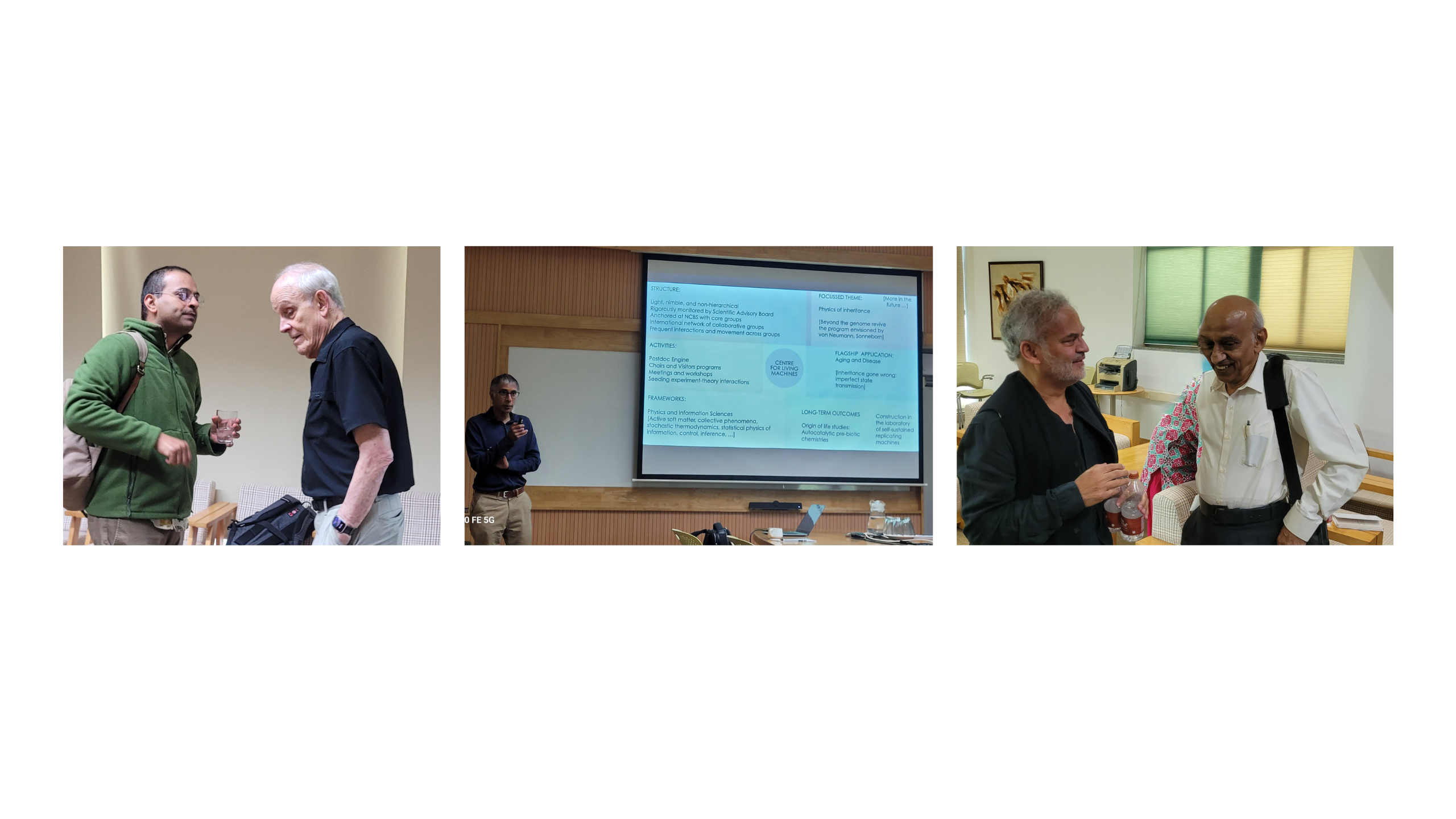
The National Centre for Biological Sciences, Tata Institute of Fundamental Research (NCBS-TIFR), Bengaluru, hosted a high-level scientific gathering bringing together globally renowned scientists and science leaders to deliberate on a new interdisciplinary research initiative titled “Physics of Inheritance and Aging,” anchored at the Centre for Living Machines (CLM), NCBS.
The meeting featured participation from leading international and national figures, including Nobel Laureate Prof. David Gross; Shri Kiran Kumar, former Chairman of the Indian Space Research Organisation (ISRO); Prof. K. VijayRaghavan (Emeritus Professor, NCBS, and former Principal Scientific Adviser to the Government of India); Prof. Sharad Ramanathan (Harvard University); Prof. G. V. Shivashankar (ETH Zurich); and Prof. Rajesh Gopakumar (Centre Director, ICTS-TIFR).
NCBS has a decades-long track of integrating physics and biology to gain insights into how living systems function, reflected in its growing “Physics of Life” ecosystem of research programs, workshops, and training initiatives, including a joint PhD program with the International Centre for Theoretical Sciences (ICTS). Building on this foundation, and the success of the Simons Centre for the Study of Living Machines, the new initiative aims to reframe inheritance as a problem of the reliable transmission of biological structure and function in noisy, non-equilibrium systems, and to extend this perspective to understand aging as imperfect state transmission across time. By integrating theoretical physics, information sciences, experimental biology, and advanced computational and AI-driven approaches, the program seeks to establish new principles for understanding living systems, with aging as a flagship application of broad relevance to health and society.
The initiative envisions a long-term ecosystem for research and capacity building, supported by sustained international collaborations, postdoctoral programs, focused workshops, and new experimental and theoretical frameworks. It also aligns with emerging efforts such as CALIBRE (Centre for Artificial Learning and Intelligence for Biological Research and Education) and other international partnerships.
These deliberations mark an important step toward positioning India as a global leader in the next phase of foundational research at the intersection of physics, biology and computer science.
Reflecting on the importance of interdisciplinary science, Prof. David Gross, Nobel Laureate in Physics, known for his work in theoretical particle physics, highlighted that understanding the physics of living systems represents one of the most exciting scientific frontiers of our time. He emphasized that sustained and flexible support from both public and philanthropic sources will be essential to advance such long-term scientific efforts. He also appreciated the quality of research being carried out at NCBS and ICTS.
Shri Kiran Kumar underscored the importance of bringing together diverse scientific disciplines, from physics and mathematics to AI and space science, to address fundamental questions such as the origin of life and the mechanisms of aging. He noted that India is well positioned to lead such multi-institutional efforts through collaborative research.


0 Comments